

Chapter 1
Citroën in Indochina, A Century-Old Story

Long before the LaDalat was born, Citroën had already made Saigon its home. In 1919, the very year the brand was founded, Émile Bainier, a multi-brand importer, became Citroën's exclusive agent for all of Indochina. He opened the first Citroën dealership in Saigon, and within two years multiple sales points had spread across the region. Citroën rapidly became, alongside Renault, one of the best-selling car brands in the French colony.
In 1933, following the economic crisis, Citroën reclaimed its distribution rights for Indochina and established the "Garages Citroën," which in February 1936 became the Société Automobile d'Extrême Orient (SAEO), the very company that would go on to build Vietnam's first car.
In 1957, the iconic Citroën DS arrived in Vietnam. Success was immediate, hundreds of orders poured in. But that same year, the South Vietnamese government introduced import quotas on automobiles, forcing Citroën to cancel most orders. Sales collapsed.
In September 1966, the South Vietnamese government banned all automobile imports from France, in retaliation against General de Gaulle's Phnom Penh speech. Citroën's future in Vietnam was in serious jeopardy, and this very ban would paradoxically give birth to Vietnam's most iconic car.
Chapter 2
A Difficult Birth, The Making of a Legend
The Idea: Build a Car in Vietnam
 In 1968, Jacques Duchemin, the newly appointed director of SAEO, proposed to the South Vietnamese government a bold solution to the import restrictions: build a car locally, using the Citroën 2CV as a mechanical base. A precedent existed, in 1963, a Frenchman from Abidjan had done something similar, creating the Baby Brousse, which later became the FAF (Facile À Fabriquer, Facile À Financer).
The South Vietnamese government, eager to develop local automotive industry, gave its support, with one critical condition: the parts could not come from France.
May '68: A Meeting That Changed Everything
While France was paralysed by the events of May 1968, Duchemin flew to Paris to meet Raymond Rozehnal, Citroën's director general. The country was on the verge of shutdown. He secured a last-minute appointment and presented his project. After just thirty minutes, he left with the boss's blessing, an extraordinary outcome given the chaos surrounding the meeting.
The Belgian Solution
The import embargo applied to parts from France only. Citroën's factory in Brussels-Forest, Belgium was the answer. From there, they shipped only the essential mechanical components: engines, gearboxes, electrical systems, suspension arms, braking systems, wheels and steering wheels. Everything else would be manufactured locally in Vietnam.
Whereas importing a full 2CV required 10 m³ of shipping volume, all the parts needed to build one LaDalat fit into just 1 m³. Up to 40% of components were manufactured on Vietnamese soil.
The Name: LaDalat
 A name had to be found, one that represented Vietnam, easy to pronounce and remember for everyone. Dalat? Or better yet, LaDalat? Đà Lạt is a beloved city in Vietnam, renowned for its temperate climate and quality of life. The name felt perfect. LaDalat was born.
The SAEO workshops were too small for assembly, so Citroën purchased the former Bastos tobacco factory, a 15,600 m² facility between Cholon and Saigon. The workshops and company offices moved there, and production began.
Chapter 3
The Car, Design, Models & Commercial Success
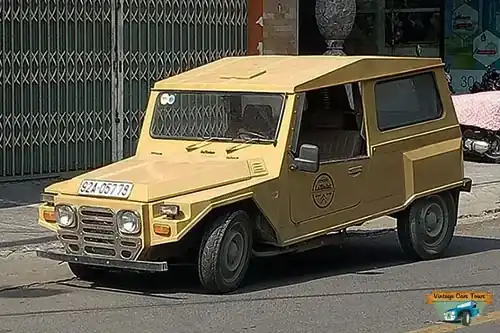
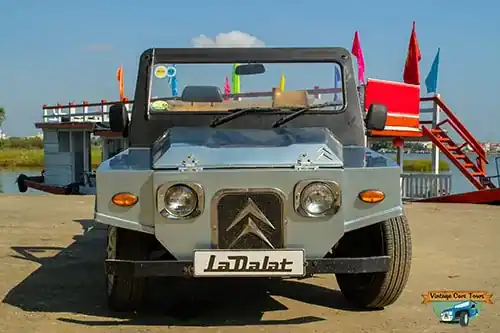
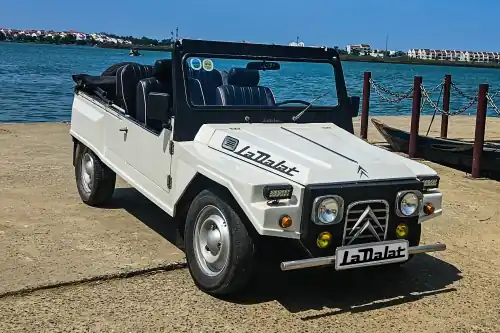
 The first LaDalat was presented to the press in Saigon at Christmas 1969. Its silhouette fell somewhere between a Jeep and a Méhari, Citroën's folded-sheet-metal convertible released in France just the previous year. Weighing just 650 kg, it was fitted with the 602 cm³ engine and the 2CV Camionnette AK chassis. The spare wheel sat under the bonnet and the windscreen could fold flat.
Its success was immediate. Being the only car made in Vietnam, it appealed to families, plantation owners, delivery companies and transport firms alike. It was the ideal vehicle for navigating tracks and bush paths, robust, easy to maintain, and affordable. At launch, a LaDalat cost just 242,000 piastres (≈ USD 1,210 at the time, roughly €8,000 today), almost the same price as a basic Méhari in France.
In 1970, its first year of production, 1,300 vehicles were manufactured. Three new models were added in 1971:
Fully open-top, 2 doors, 4 seats. The windscreen folds flat. The most iconic and recognisable LaDalat model.
Designed for families. An estate body style in 3 or 5 doors. The best-selling model across the entire LaDalat range.
Built to carry heavier loads. Also available as a pickup truck. The working workhorse of the LaDalat family.
Reinforced and extended. Could be fitted with 2 face-to-face bench seats in the rear, a true bush taxi configuration.
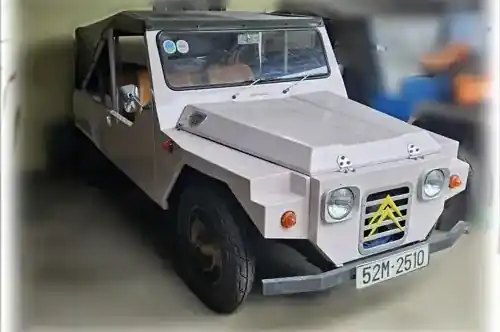
Around thirty Citroën dealers across Vietnam offered the LaDalat. Many owners modified their vehicles to suit their needs: taxis, ambulances, pick-ups, enclosed saloons. This explains why it is practically impossible today to find a LaDalat in its original factory state.
Chapter 4
The 4×4 Prototype, and the US Army
As early as 1971, Alfred Nicolas, the Citroën agent in Đà Lạt city, had the audacious idea of converting the LaDalat into a 4x4. He convinced Jacques Duchemin to back the project. After numerous attempts, using decidedly artisanal means, a working prototype was completed. By early 1972, tests revealed exceptional off-road capabilities, surpassing even the legendary Jeep, then the best-selling vehicle in Vietnam.
A new, more advanced 4x4 prototype followed: fitted with a 652 cm³ Citroën Visa engine, a lengthened and raised chassis. It was presented to the US Army, who were so impressed they placed an order for multiple vehicles. The fall of Saigon on April 30, 1975 meant this order was never delivered.
The 4x4 concept did not disappear. Citroën France repatriated the prototype's mechanical elements along with bodywork from each model produced. These became the foundation for the FAF and the Méhari 4x4, released in France in 1979. The LaDalat's DNA lives on in French automotive history.
End of Production
Between 1969 and 1975, approximately 3,850 LaDalat came off the Saigon production line. After the fall of Saigon on April 30, 1975, around 200 additional vehicles were assembled with remaining parts. Today, approximately 200 LaDalat are estimated to still be in circulation in Vietnam, often in poor condition, increasingly sought after for restoration. Vintage Cars Tours Vietnam maintains our fleet LaDalat in Hoi An for guided tours every day. The LaDalat is now a source of national pride and the driving force behind our Vietnam Memories Project, dedicated to restoring and preserving these rare vehicles.
Vietnam would wait 44 years before another car rolled out of a Vietnamese factory: the VinFast, launched in September 2019.
The Full Story
LaDalat, A Complete Timeline
Citroën arrives in Indochina
Émile Bainier becomes exclusive Citroën agent for Indochina. First dealership opens in Saigon. Citroën and Renault become the best-selling car brands in the French colony.
SAEO is Founded
The Garages Citroën become the Société Automobile d'Extrême Orient, the company that will build Vietnam's first car.
Import Ban from France
South Vietnam bans all car imports from France following de Gaulle's Phnom Penh speech. This ban will paradoxically lead to the creation of the LaDalat.
The Project is Conceived
Jacques Duchemin proposes building a local car on the 2CV base. During the chaos of May '68 in Paris, he secures Citroën HQ approval in just thirty minutes. Parts will come from Belgium.
LaDalat is Presented to the Press
Christmas 1969, Saigon. The first LaDalat "Safari" is unveiled. The name is inspired by the beloved Vietnamese city of Đà Lạt.
Production Begins, 1,300 Units in Year One
Commercial success is immediate. LaDalat appeals to families, businesses, plantations and the army alike. Thirty Citroën dealers across Vietnam sell the car.
New Models: T, R, RN
Three new variants expand the range. The T (Tourisme estate) becomes the best-seller. Alfred Nicolas begins developing the 4x4 prototype in Đà Lạt.
The 4×4 Impresses the US Army
The LaDalat 4x4 prototype surpasses the Jeep in off-road tests. The US Army places an order. It will never be delivered.
End of Production, Fall of Saigon
April 30, 1975. Production stops after approximately 3,850 units. Citroën repatriates the 4x4 prototype to France. Around 200 more are assembled post-reunification with remaining parts.
LaDalat's Legacy Lives On in France
The Méhari 4x4 is launched in France, directly inspired by the LaDalat 4x4 prototype. Vietnam's little car has left its mark on French automotive history.
~200 LaDalat Remain in Vietnam
Increasingly sought after for restoration, the LaDalat is a source of national pride. Vintage Cars Tours Vietnam operates a fleet of 5 LaDalat in Hoi An, available for guided tours in Hoi An every day.
Chapter 5
LaDalat on Screen
From the Saigon factory floor to the roads of Top Gear, the LaDalat has earned its place in automotive media history.


Ready to Travel Back in Time?
Discover the rice fields and authentic villages around Hoi An aboard a perfectly restored Citroën LaDalat.
Guided tours in English & French, every day, group & private.
Discover Our Tours
Sources & References
- Pascal au Vietnam, Citroën LaDalat, la Méhari Vietnamienne, Guide 2023
- Citroscopie N°7, Sep-Nov 2005
- Marie & Etienne Christian, 2CV Citroën ses dérivés, Baby Brousse, Dalat, FAF, L'Autodrome Edition
- 1972 Factory Report – YouTube
- Citroenet.org.uk
- Wikipedia – LaDalat (Vietnamese)